
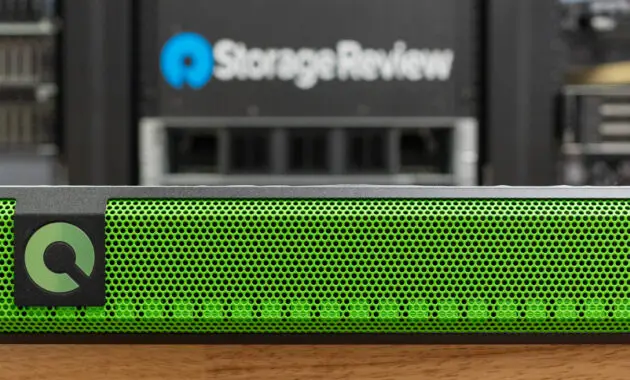
QSAN has been building enterprise storage solutions since 2004, and that experience is evident in the XN4 line. The XN4226D in our lab is a 2U, 26-bay, all-NVMe array with dual active controllers, delivering high availability as unified block and file storage. QSM 4 software adds the expected data services, including snapshots, replication options, data reduction, and a straightforward management experience. The XN4 is designed for teams that seek NVMe speed without compromising multiprotocol flexibility, all at a very approachable price.
The platform supports NVMe-oF over TCP and RDMA, in addition to iSCSI, Fibre Channel, NFS, SMB, FTP, and WebDAV. We also completed a focused NVMe-oF study comparing the behavior and scaling of TCP and RDMA. In our testing, we pushed the unit to its limit with large sequential reads, achieving an impressive throughput of 21.21 GB/s. Where this system fits matters as much as raw numbers. The XN4226D serves mixed environments that blend VMware or Proxmox for VMs, VDI, and database tiers, as well as creative file services, AI inference nodes that require predictable NVMe paths, media backups, and high-bandwidth ingest for surveillance and sensor workloads. The QSAN XN4226D is well-suited for nearly any workload.
Ultimately, the value is straightforward. You get unified high availability, NVMe throughout the chassis, and I/O choices up to 100GbE or 32Gb Fibre Channel as needs grow. Performance tracks what many tier-1 arrays deliver, while licensing remains more approachable, and protocol coverage remains broad across NVMe-oF, iSCSI, Fibre Channel, SMB, and NFS. For shops eyeing InfiniBand but constrained by budget, QSAN’s Ethernet approach offers near-IB responsiveness on standard gear at 100 to 200GbE scale.
For teams that prioritize real-world application results, QSAN’s longevity, intuitive software, and clean hardware design make the XN4226D a credible all-flash workhorse to build around.

QSAN XN4 Hardware
QSAN XN4 series storage arrays come in a 26-bay, 2U, 19” rack-compatible server chassis, with single or dual-controller options housing 4- or 8-core Intel Xeon CPUs to fit the redundancy and performance needs of the smallest and largest operations. With all 26 bays populated, a single XN4 series chassis can hold up to 798 terabytes of data on 2.5” U.2/U.3 NVMe solid-state drives. Up to 20 SAS-connected expansion units can also be added, increasing the total capacity of an array to a massive 16.773 petabytes.
Each controller onboard features a single 2.5 Gbps RJ45 Ethernet port, four 10 Gbps SFP+ ports, and two 12 Gbps SAS wide ports. There are also upgrade options for 10Gbps RJ45, 25Gbps SFP28, and 100Gbps QSFP ports. Fibre Channel support can also be added, with 16Gbps SFP+ and 32Gbps SFP28 adapters.
The table below compares the specifications of the XN4226D-4C and XN4226S-4C storage systems. These are the 4C variants, designed with either dual-active or single-upgradable controllers depending on the model. For deployments that require more processing power, an 8C version of these systems is also available.
QSAN XN4 Capabilities
XN4 arrays come standard with the latest connection protocols required to support high-performance compute and data-hungry AI models, including NVMe over Fabrics (NVMe-oF) served over TCP and RDMA. Connections over iSCSI, NFS, FCP, CIFS/SMB, FTP, and WebDAV are also possible, allowing the array to meet the block and file storage needs of data centers with a mix of legacy and bleeding-edge systems.
The Advantages of NVMe-oF
While protocols such as iSCSI, NFS, and FCP are still widely used in enterprise storage applications, NVMe-oF offers significant improvements in latency. NVMe standards were designed from the ground up for solid-state drives connected directly to a system’s PCIe bus. In contrast, older protocols like iSCSI and NFS were developed around the limitations and slower access times of traditional hard disk drives. In almost every case, NVMe-oF technologies outperform older connection protocols, with higher bandwidth and faster access times. NVMe-oF can also leverage network interfaces with Remote Direct Memory Access (RDMA) capabilities, enabling data to be transferred directly to the memory of a target computer without requiring CPU processing.
Data Reduction and Optimization Features
The high-performance hardware stack of the XN4 storage array is further enhanced by numerous software features that are well-known and appreciated by storage administrators. Thin provisioning, compression, and deduplication enable businesses to maximize their SAN capacity, while SSD caching and automatic storage tiering accelerate access times for frequently used files and objects. The appliance’s QSM 4 operating system also makes it easy to test and roll back changes with built-in snapshot tools.
Security and Management Features
QSAN has taken into account the evolving security and management requirements of its customers with the XN4 line. The XN4 is compatible with Instant Secure Erase (ISE) and Self-Encrypting Drives (SED), as well as security protocols such as SSL/TLS, authentication via Role-Based Access Control (RBAC), and support for Active Directory/LDAP servers. The array can be managed using an HTTPS web UI or a RESTful API, enabling automation through a wide variety of tools, such as Ansible or Terraform.
QSM 4 Management
QSM 4, the operating system of the QSAN XN4 series, makes setup and management of the storage array easy for storage administrators of all experience levels. Out-of-box deployment is simple: fast pool creation, intuitive host assignment, and lightweight management via web UI and REST APIs—all designed for smaller IT teams without deep storage expertise.
The Dashboard screen displays system status information and recent events logged by the server.